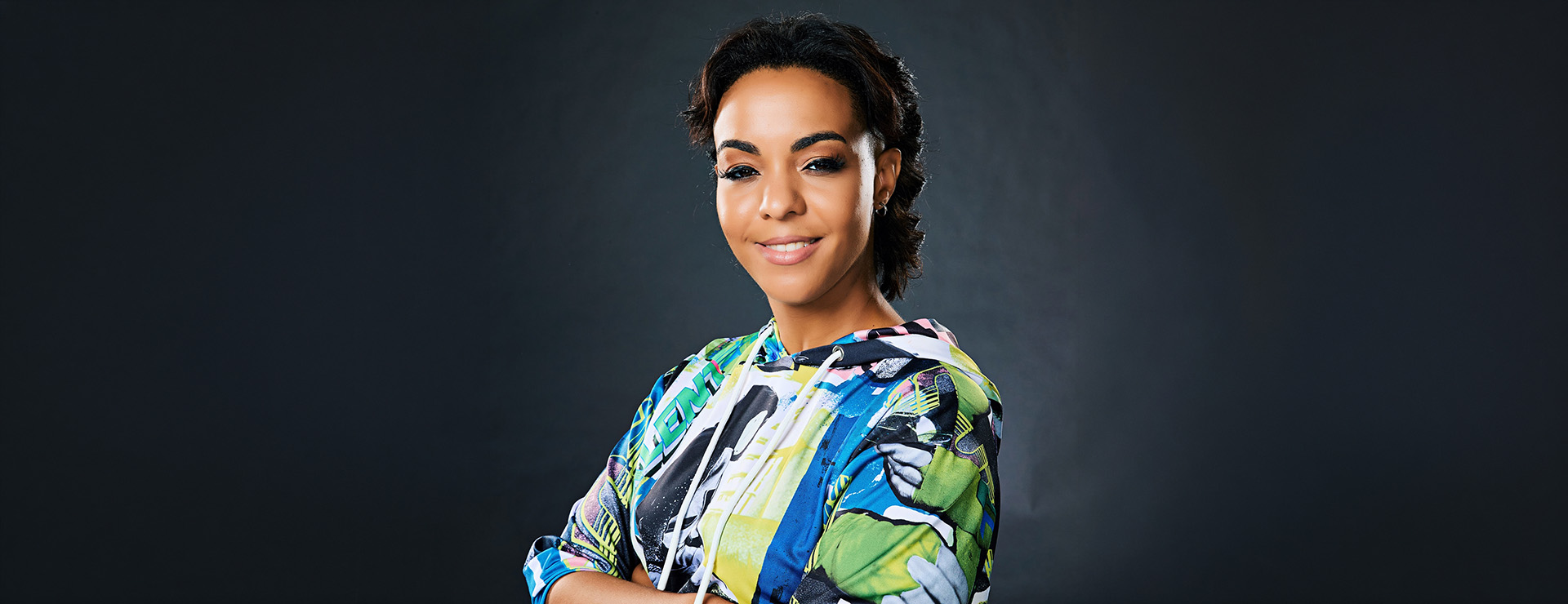

Summer Blair’s journey at The Walt Disney Company in London is a testament to the power of her perseverance, passion and adaptability. Starting as an intern and navigating the television industry’s ongoing dramatic shifts, Blair has quickly risen through the ranks to become a production manager overseeing linear promos and brand campaigns across Disney’s linear channels in the Middle East.
Blair is still early in her career, but already her impact extends beyond implementing production workflows and making sure all the marketing trains run on time. She is active in Women@Disney; is an international council member for GEMA’s EmpowerHer, fostering community and mentorship in the UK and beyond; and she’s already served on the jury for the GEMA UK Awards.
In this conversation, Blair talks about her career trajectory, balancing legacy TV with digital innovation, navigating AI and advocating for the next generation of creative leaders.
Spotlight: Give me a brief recap of your career thus far and how you got to where you are now.
Summer Blair, production manager, The Walt Disney Company, London: All of my professional career has been spent at Disney. I've primarily worked across linear TV promotions. I started as an intern between my second and third year at the University of Portsmouth on the Disney Channels team, working on promotions for Central Eastern Europe and the Middle East. COVID-19 struck in 2020 just as I was graduating from university. I thought I had no hope of getting back into the industry, but my former manager reached out on my birthday with a freelance opportunity on the National Geographic team. I jumped at the chance and returned to Disney in June 2020 as a production coordinator across the National Geographic and Wild channels. There, I focused on UK campaigns and social outputs alongside EMEA oversight. I also managed full marketing campaigns for such Nat Geo shows as Car S.O.S, Air Crash Investigation and Trafficked with Mariana Van Zeller.
Later, I was promoted to production supervisor, expanding my work to general entertainment brands like Fox. That role involved EMEA-focused branding and campaigns for various shows and served as my first step into production management. After an organizational restructure, output for Middle Eastern channels moved to London. Our team expanded, and I took on the role of production manager. It was a huge undertaking—migrating nine TV channels, including general entertainment and National Geographic feeds, into our London workflow. Over the last three years, I've managed the creative team producing promotional and trailer content for our Star channels in the Middle East.
Spotlight: What did you initially think you would be doing when you graduated from university?
Blair: I've wanted to work in TV for as long as I can remember. When I was younger, I wanted to be a TV presenter, but as I grew older, I realized I preferred being behind the camera managing and organizing. I always loved television and radio and initially envisioned a career in long-form content. However, during university, I explored different areas, realized the key role advertising plays, and secured an internship at Disney. I fell in love with marketing and the challenge of conveying a story in a short time frame, as well as the fast pace of the work.
Spotlight: What recent campaigns have you particularly enjoyed working on?
Blair: Many of the programs and films across our general entertainment channels are older, so a lot of our work involves bringing fresh life to familiar content. A personal favorite was promoting the Twilight saga. Having grown up watching it, working on those promotional stunts was really rewarding. It's a blend of appealing to nostalgic fans while attempting to introduce the content to new viewers. On the other hand, with National Geographic Abu Dhabi—a free-to-air channel for a local audience—event-focused programming performs exceptionally well.
Spotlight: You started at Disney in 2020 and quickly became involved with GEMA and EmpowerHer. How did you discover GEMA so early in your career?
Blair: Our team was heavily involved in submitting entries for GEMA nominations. As a production coordinator, my job was to collate award submissions, which was how I first learned about GEMA. From there, I began participating in online peer judging. A few years ago, I was invited to join the jury in London, specifically for the Newcomers Award, which was a fantastic opportunity to network and evaluate upcoming talent.
Alongside that, I became involved with Women@Disney, our employee resource group for women. I aligned closely with their values and wanted to build connections across the business. I joined their committee as events lead. Around the same time, I noticed GEMA’s EmpowerHer initiative launching in the U.S. because I was following them on Instagram. When they posted a call for international expansion, I applied and joined the council. It has been a wonderful platform to connect with women across the industry, share common experiences and build community.
At the GEMA awards in Amsterdam last year, I had the honor of co-presenting the inaugural EmpowerHer Spotlight Award to RTL’s Maraya Tifres alongside GEMA Marketing Director Kayla Karlsson. Following that, we collaborated with GEMA to co-host an event coinciding with the UK Awards, which further established our partnership.
Spotlight: Tonight GEMA is partnering with Women@Disney to host an EmpowerHer event at Disney’s London offices. What do you hope to achieve with this event?
Blair: The event centers on the theme of "HerStory: Every Career Has a Story," blending Disney's heritage in storytelling with EmpowerHer's mission. We wanted to design an event where attendees gain actionable insights and engage in meaningful conversations, rather than passively listening to talks. We begin with networking activities and storytelling activations focused on career growth. Next, we are hosting three fireside chats with interactive Q&A sessions. Our speakers include National Geographic explorer Tamana Ayazi, Disney employees from technical and sales fields, and senior leaders Landy Slattery and Anna Priest from Channel 4 and Paramount [respectively]. We want attendees to leave feeling empowered and connected to a supportive professional community.
Spotlight: Along those lines, what issues and dynamics do you think women who work in this industry face today?
Blair: The members of Women@Disney focus on three primary areas: career progression, women's health and community building. Regarding career growth, we explore strategies for advancement, lateral moves and visibility. For women's health, we have prioritized open discussions around topics like hormonal health and menopause awareness to destigmatize these subjects in the workplace. Lastly, we emphasize cross-functional networking to help women build broader professional connections within the company.
Spotlight: As part of EmpowerHer and Women@Disney, you've worked to foster community and create pathways for women. What steps can companies take to help advance this agenda?
Blair: I think a lot of it comes down to providing people with exposure and tangible opportunities. People in senior leadership positions can actively advocate for emerging talent by offering stretch assignments, delegating high-visibility presentations and creating platforms for junior staff to lead. From a personal perspective – and this doesn’t come naturally to me – putting your hand up or putting yourself forward helps you to be more seen and heard in the workplace. I think new opportunities often come from outside of your comfort zone. Structurally, I think organizations would benefit from a shift in attitude. Just because something has been done a certain way for a long time doesn’t mean it needs to continue to be done that way.
Spotlight: What advice do you have for women entering this space on sustaining momentum and preventing burnout?
Blair: There's always something that someone's waiting for that is due tomorrow, is due now, was due yesterday. I think a lot of it comes down to really loving and having a passion for what you do. That’s the drive that fuels you to do it.
I also think it’s about using available tools, like AI, to your advantage. And that requires carving out time to learn how to use these tools. Investing a few good hours into an AI program might help you streamline your workflow or a project down the road. It’s hard to find the time to do that when the wheels are constantly spinning but if you put in that effort now, you’ll have a solution further down the line and you can buy yourself back some time.
I also think it’s always worth reviewing where the pressure points are in your processes. Ask yourself if these are recurring patterns and if they are, is it better to stop and try to work out what’s going wrong rather than just trying to fix it all the time.
On the flip side, avoiding burnout is also about just being able to turn off from time to time. People find comfort in all different places. I find mine in spending time with my family and friends.They’re my peace and my comfort outside of work.
Spotlight: I agree that AI can streamline work significantly, although people sometimes feel uncertain about how much to rely on it. What is your relationship with AI?
Blair: I do think it’s easy to feel like AI has done something in two seconds that maybe would have taken me an hour, and that can feel worrying, but I think it’s about trying to use it cleverly. I’m keen to learn more about it and see what I can do with it. AI is meant to work to your advantage and to make your world easier, not the other way around.
Spotlight: What are some of the short-term industry trends that you are observing?
Blair: In terms of AI, I think we’ve steam-rolled through a period of experimentation. I think 2027 will be more about refining how we use it and understanding where it genuinely adds value, rather than just asking it to do easy tasks for you.
I think people are much more aware of AI now, and there’s almost this kind of anti-AI trend where people want the human craft back in their creative. So I think it will rebalance out. I don’t think it’s going anywhere, but we are learning where we can best use it effectively and it’s not just a quick fix for everything.
Otherwise, a trend I’m following is the shift away from the idea that the future is linear versus streaming. I feel like over the past 18 months to two years, we have been seeing a lot more balance in the viewing figures between linear and streaming. There’s still a real need and want for live experiences and for those water-cooler moments when everyone tunes in to watch a specific show. I feel like the viewing numbers seem to have stabilized and in some cases they are actually increasing. For example, the finale of Celebrity Traitors last month on BBC One was watched by a peak audience of 11.6 million viewers with nearly a 63% share of the TV audience.
I wonder if that’s happening because there’s a kind of streaming fatigue going on. People have so much to choose from and with their busy lives, sometimes they just want the simplicity and familiarity of traditional television where they can just flick through and find something to watch. Whether it’s on social, whether it’s on streaming, whether it's on linear, I feel like there’s a place for all of it. Having come from a linear background, it’s nice to see that stabilize a bit.