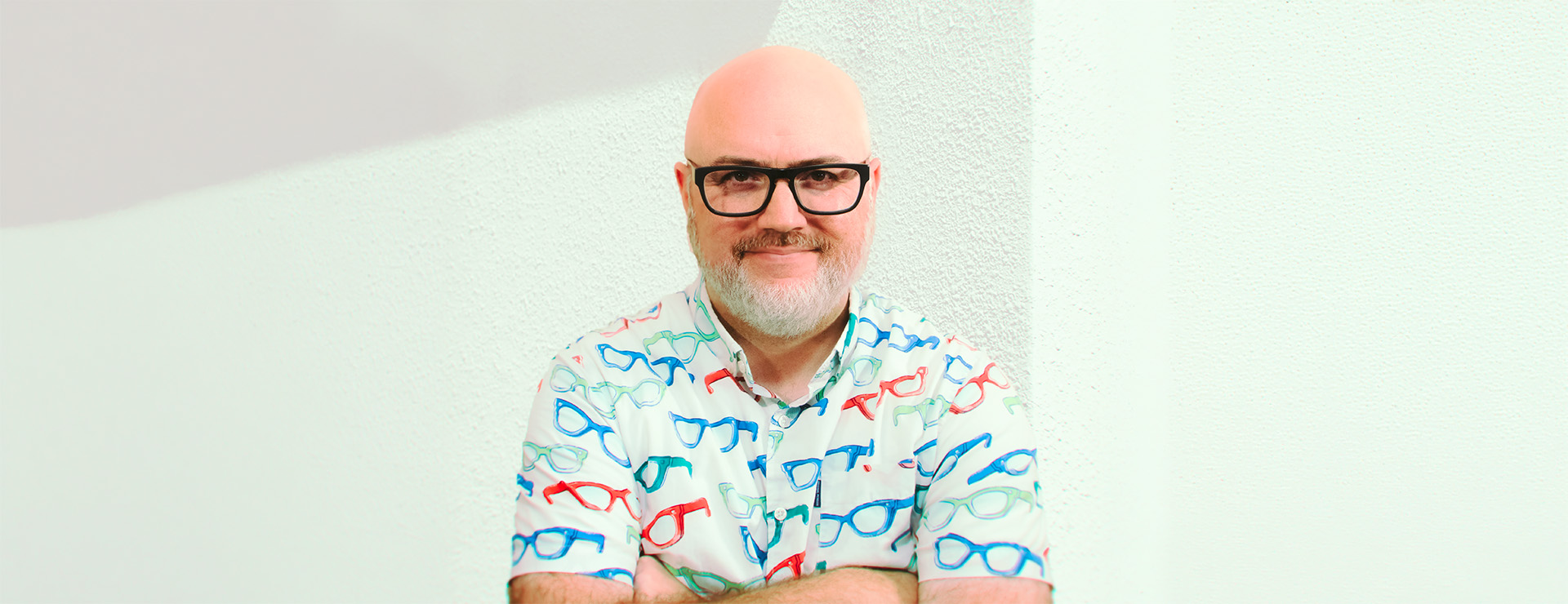
You know when you meet up with someone and you just vibe? That’s talking to Sarkofsky Creative Innovation Lead Ryan Summers, who so easily turns everything into a conversation that it’s hard to remember you are supposed to be doing an interview.
Summers, a chemical engineer turned animator and motion designer, has had a long career at some of the top entertainment marketing agencies in the industry: Imaginary Forces, Digital Kitchen, Spillt and now Chicago-based Sarofsky, working with founder Erin Sarofsky.
At Sarofsky, he has a sort of dream job – combining motion graphics and animation with AI and other emerging technology to create best-in-class work for brands. Summers joined Spotlight to share a bit of what he’s thinking as new technology once again forces the industry to reconcile how it creates.
Spotlight: A topic you frequently comment on publicly is how to build trust in brands, and how you think that motion design – and design in general – helps brands build that trust. Throw artificial intelligence (AI) into the mix, and what does that do to trust?
Ryan Summers, creative innovation lead, Sarofsky: There's so much competition now that it's hard for anyone to stand out using the old rule book. There's a reason that every brand, every tech company, uses the same font, that everybody's using the same color palettes – it’s because they feel like that's what cuts through. We've hit this critical mass where if you're an emerging brand or a challenger brand, you know you’ve got to do something different.
Add the fact that most customers are now interacting in non-traditional ways. People are making their decisions not when they walk through the grocery store and look at prices, they're making their decisions on their phone, they're making their decision when they pause on Amazon and an animated video comes up and says something to the effect of, ‘Are you about to get a drink? Buy Lipton ice tea,’ and you can make a purchase decision right there.
Motion is such an important part of consumers’ decision-making process and it’s never considered. It's why I keep on talking about motion systems or motion branding as the new frontier. Every brand will spend six figures to create their design bible. Very rarely is motion ever a part of that.
People will come to us and say ‘make us a commercial,’ and we’ll ask, ‘where are your motion guidelines?’ That stuff is never considered so everything moves the same. But more and more, we’re finding that people are looking to incorporate motion. An additional part of their brand signature is how and why something moves. That’s becoming a bigger thing for us to help brands develop, rather than adding it in at the last second.
When you do that at the beginning, now wherever you go, whatever screen your brand is on – whether it’s a football stadium and a 20,000 pixel wide screen or on someone’s phone – when the consumer is about to hit purchase, it’s all aligned.
Spotlight: I think it happens pretty frequently that a brand comes to an agency, and they want a campaign for something, but when you say, ‘let's back up. Tell me what your brand guidelines are or what your brand principles are,’ they don't have any of that. So then it's like, where do we start? Do you pull them all the way back and develop that structure, or do you say we don't really have time for that and go from there?
Summers: That's honestly my favorite moment, because then what I get to say is, ‘we're not going to solve the whole problem right now, but maybe we can pick a specific deliverable or a specific asset to start with,’ like an end-tag or a main-title sequence. Then we work together to figure out how this thing connects to all this other work they’ve done for the past 10 years. If we can find that connective fiber together, that spools out into ‘we made that decision, here's a whole history of other decisions we could start making together.’
It comes back to me trying to be of service to the client.
I'm not just trying to win the end-tag job and get paid and walk away. I want to figure out how this will integrate into everything else the client is going to do.
Spotlight: It's interesting because you're a motion designer and an animator, but you talk like a brand strategist.
Summers: Animation kind of leads to that. I have this weird background of character animation and brand, and then experiential like activations and installations. What's the connective tissue between all those things? It's ‘what's your brand? What's the meaning behind your brand?’
Especially as these companies keep getting bigger and merged and acquired, it's hard to keep all of that true and honest. You need partners to help you, remind you, and tell you where something needs to change.
Spotlight: Don’t you think that if you have all of that laid down upfront, it’s easier to make decisions later?
Summers: I would say it's two things: it lets you make decisions later and it also lets you be much more comfortable with risk, because it is so much easier to make calculated risks once you have defined what your brand is. If you start figuring out how you speak through motion, it gives you confidence to try something new. I've had it happen so many times where people think their brand assets move in an ownable way, and then you show them the top-10 companies’ end tags of the last two years, and show them that the way they are doing their animation and motion looks like these four other companies. My question is then, ‘how can we make it distinct and ownable, so that every time someone sees it, it looks different, it moves different and sounds different from everybody else.’
Spotlight: To tie all of this back to my original question, how do you think all of that builds brand trust?
Ryan Summers: It helps you cut through noise. If you're repeatedly hitting people with all of that all the time, it helps them identify you, and it also helps them make a decision on whether or not they want to associate with you. It helps you create affinity, and motion is just another component of that.
Spotlight: We all live across screens now. Perhaps motion didn't used to be so important but now everybody's on one screen or another all the time, so you do have to think about motion more.
Summers: I think motion has always been an afterthought. That was probably justifiable due to the sheer amount of decisions you had to make as a brand, you could always kick that to the side, because you had to figure out the poster and the out of home and what you were going to put inside the train. There just weren’t that many surfaces where things moved, let alone interacted. Now, every bit of signage is becoming digital and interactive.
Spotlight: Let's get into the AI of it all. AI clearly has a role to play in all of this, but there are also already a lot of instances where AI usage has caused consumers to lose trust in brands. How do you marry the two things together – more motion, animation, interactivity and even personalization – with AI?
Summers: I think the overwhelming negative response to brands using generative AI to create advertising – andthen making the selling point that they did that – is not the way to do it. There’s a massive amount of ads that have used AI in ways you probably don’t expect. It’s a lot like visual effects. When a movie is only about visual effects, that can be very grating to people, but if the visual effects are invisible or they’re there to support the storytelling, it’s acceptable.
It’s interesting to me that we skipped past the initial love affair of a shiny new thing and went straight to ‘I don’t want anything to do with that.’ I don’t think you make AI the center of it all. My discussion about AI right now is completely separate from the ethical, legal, moral things around AI. Those are all decisions everybody has to make on a client-by-client, person-by-person basis, and it can affect the morale of your team.
I think the more interesting parts that we are starting to dabble in are taking any of these things that are very expensive, and looking for ways to use them to extend the audience's ability to connect or to interact with a brand. Even if you’re just talking about a mascot or an ambassador, there are so many characters that just go moribund in between campaigns. It takes so much money to build an animated character for a brand, but then after that it goes away, it just sits on the shelf.
We've started developing systems using AI, trained off of all the work we do, to allow brands to use a character in a way that actually interacts and responds directly to you. Imagine you're on Instagram and you see a commercial with whatever character, and you respond, and the character within three minutes replies back to you, sends you a DM, and starts having a conversation with you.
This ability to have interactions that extend from the primary campaign takes the best of both worlds. You can do something in the traditional way, where you animate something, whether in 2D or stop motion. You can train the tools based on work you have made, not something that somebody else did, and you can enable a social team to be able to interact with the audience in an automated but personal way.
You always hear about your 10,000 fans, your street team, the most vocal people that basically do your promoting for you. Every brand is looking for that. That's why they hire influencers, because they want to get the loudest people for the lowest amount of money. Imagine that your brand could essentially have a mascot that's like an influencer without all the potential backfires where the social media influencer did this crazy stupid thing on his live stream at two in the morning.
Imagine you had that, but you controlled it and you could have meaningful actual engagements with it. We've done this with a character for a brand that was about celebrating people’s actions and it was really powerful.
Spotlight: What character was that?
Summers: We did a campaign last year for the Petro-Canada Caremakers Foundation, which wanted to recognize Canada’s eight million unpaid caregivers through its ‘Give-a-Honk’ campaign. We created an animated goose that interacts with people on social media.
If you can create a character that people can continue to interact with, and have a sort of mini-relationship with, that’s where we’re headed with animated characters and brand mascots.
Spotlight: Do you think that's more impactful if it's a brand mascot that is very well known, like Mickey Mouse?
Summers: I think it's the reverse. I think it's more impactful for challenger brands that didn't think this was possible, because you're creating a closer relationship with those initial people who fall in love with the brand, like an emerging brand who's trying to find that audience. I think it's more important for that, because people already have established expectations and relationships with Mickey Mouse or Bart Simpson. The amount of wonder or discovery you can have with those characters is pretty limited.
Spotlight: So in this case, it’s about using AI to animate that character and make it interactive, but how that is done is not something people need to know about.
Summers: Two months before the goose became a possibility, I was staunchly anti-AI. I was like, 'I'm an animator, I can tell the difference.’ The stuff I had seen coming out of AI animation felt like slop, it felt directionless. It didn’t feel like anything was done with intent.
But when we did this project, we animated 15: and 30: second animations, and we had a core team of animators that did a ton of tests with me to design the character – how the character acts and what its personality is. We spent weeks developing it. We weren’t focusing on the AI of it all. It wasn’t about the fact that this character was created using AI, it was about the fact that it was reacting to you. And it wasn’t like we made six animations and you would just get one of the six that automatically swapped your name in. You could actually make it respond to something very specific, like if you knew a caregiver, you could actually have the goose send them a message celebrating their efforts.
Spotlight: I feel like when people freak out about AI, it’s because they don’t really understand how to use it yet.
Summers: In this case, someone might say ‘AI is replacing an animator,’ but my response to that is ‘this job would have never existed if we had to animate it on our own.’
This is not taking something away, this is a new output capability that would not exist but for AI.
I was actually able to get more money for this campaign by adding this capability. Everything we made was going to training this capability. We were never going to be able to get money to have a team of animators making 750 bespoke animations, but because of AI, we were able to create this experience.
Spotlight: So that’s an example of using AI for good. You don’t have to name names, but are there things that you’re seeing brands do around AI that causes people to lose trust?
Summers: My big theory right now is that making things that look pretty or complicated to make is becoming table stakes. They are no longer the key differentiators, although they used to be because they were hard to acquire. Today, everyone can use AI to create Pixar-style visuals, but it’s not just the visuals that makes Pixar great – it’s the storytelling, the ability to understand how to communicate with heart, and getting to true emotion.
Now you are seeing people basically just grafting a sh—ty script that hasn’t been thought through, that’s either been prompted or typed out as fast as possible, on to these visuals. But they don’t realize that because everybody has access to the same thing, it makes those spots look like clip art even though it looks pretty.
That's what I'm seeing brands and studios do. Even if it looks pretty, it looks like everybody else's thing.
That's the number-one rule we've always had: you need to make something that feels unique to the company, that's true to its brand positioning, and is ownable.
Spotlight: I think you can use AI to produce all day long, but it's not going to change the value of human creativity.
Ryan Summers: It’s the writing, it's the editing, it's the camera choices. You can generate 7,000 camera shots, and maybe right now it takes four days to do that, and in a year it'll take 10 minutes. You still have to decide where to put them, what it is you're trying to, what reaction you're trying to create.
That's infinite, right? There's infinite choices, but humans who have done this for a long time, that have dedicated their life to it, know which one goes when and where for that specific brand or that specific story. To me, the beauty and the crutch of these AI tools are that they basically give you infinite shots at something.
Spotlight: I do think everyone needs to have some creative boundaries, something around which you're making a decision, or else you'll never make anything with clarity or vision; it'll just be mushy.
Summers: I think that's why people call this stuff slop. They're like it's pretty, but there's no rhyme or reason. I think people can sniff out intention.
I remember when I went and saw Sinners on opening night, It was such a crazy home-run swing. Sinners director Ryan Coogler got a blank check to make his own thing, and you don't see that very often. [George] Lucas got that with Star Wars, [James] Cameron got it with Avatar, but otherwise you don't get that very often. With Sinners, within 30 seconds of the movie starting, I felt my shoulders relax, because I knew I was being taken on a ride by somebody who knew exactly what they wanted.
I think a lot of times AI is the exact opposite. It feels mushy because it’s like, ‘here’s a bunch of stuff and I just put it together, hope you like it.’ That’s the exact opposite of what we respond to as people.
Spotlight: Last question: What's the last creative thing you've seen out in the world that you thought was incredibly cool?
Summers: I just saw this thing recently that somebody did. I don't even know what it was for. It’s this really amazing journal-slash-sketchbook. Every page, when you turned it, had all these little things that were almost like a peekaboo thing, you could lift and peel up, and it'd have something like seven different things folded.
That is the epitome of what I'm talking about. How do you build trust as a brand? You create these moments of discovery and these unexpected things in a way that feels like a person made it, whether you made it with AI or not. It doesn't matter how you got there, it's the feeling you get when you watch it. It’s always about trying to get an audience to come closer, lean up in their seat, get closer to the computer, or hit the like button.