
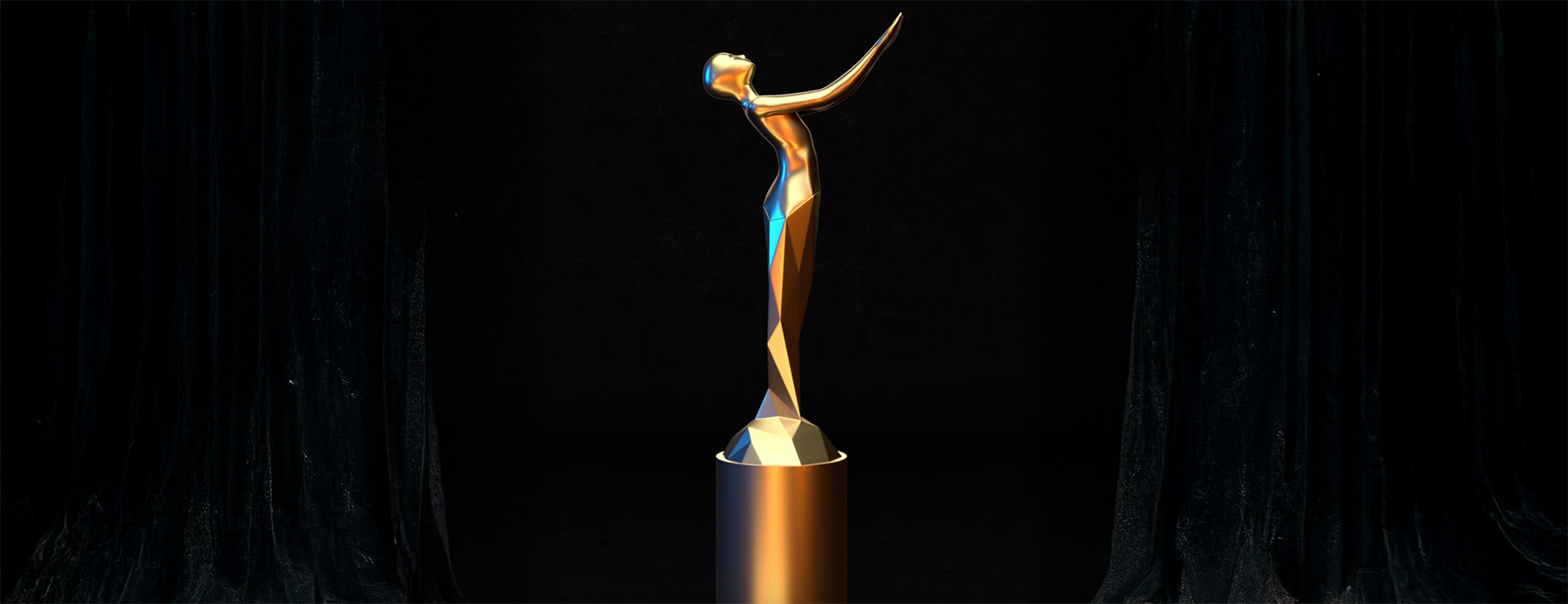
2025 was the year in which the Global Entertainment Marketing Academy of Arts and Sciences – GEMA, formerly Promax – solidified its new brand, offering awards shows in Europe and the U.S. that showcased the academy’s new multi-faceted focus on entertainment marketing beyond just television.
A huge part of that evolution is GEMA’s elegant new statue, designed in close collaboration with members of the creative team at Fox Entertainment under the leadership of GEMA Board Co-Chair Scott Edwards, executive VP and head of creative advertising; Ian MacRitchie, senior VP, visual innovation studio; and Jesse Hallas, VP, broadcast design team.
Edwards and Hallas joined Spotlight to discuss the thought process behind the statue’s evolution, which was unveiled at this year’s GEMA Awards in Los Angeles in October.
Spotlight: Why did GEMA feel like the statue needed a redesign after nearly 70 years?

Scott Edwards, head of creative advertising, Fox Entertainment and GEMA Board Co-Chair: I think the main reason was the organization’s overall rebrand. What is the representation of the organization that’s the most prevalent and seen and physically represented? It’s the statue, the award. That became the discussion - we should evolve the statue – and we at Fox asked how we could help.
Spotlight: Why was the Fox team willing to step up and do this? It seems like a lot to take on as a side gig.
Edwards: We are stretched awfully thin so we hired an outside designer and 3D modeler when we were trafficking this through a busy window. We also hired a sketch artist with an outside house with whom we have a good relationship. We had 50 different sketches of what this could look like before we got into the 3D modeling piece of it
Jesse Hallas, VP, broadcast design team, Fox Entertainment: I like creative challenges and it was fun working on something that stretched our creative chops and got us away from just working on flat graphics.
Edwards: We are always like, ‘if there’s a stretch assignment, please let us know.’ This was certainly a stretch assignment.
Spotlight: Having gotten back 50 or so sketches, how did you land on the final model?
Hallas: Through trial and error, sharing and getting feedback. Some of the stuff in the sketches was going to be physically challenging to put into statue form so we had to consider what would be practically possible. That helped us start to narrow down the field. We ended up with four or five sketches that felt unique and creative that we could execute. The initial challenge was thinking outside the box. There were a lot of things in those initial sketches, like floating blocks. Those weeded themselves out because we obviously wouldn’t be able to render them in 3D.
Edwards: There were a number of conversations between me, [GEMA President and CEO] Stacy LaCotera, [Fox Entertainment SVP, Visual Innovation Studio] Ian [MacRitchie] and Jesse [Hallas]. We also looked at the various awards statues in our offices – such as the Clios or the Golden Trailer statues. We held them in our hands and considered the feeling of holding them. We wanted to make sure to protect the experience of holding the statue in your hand, including the fit and the ergonomic grip, especially as we approached the design sketch to 3D modeling.
We wanted the new statute to be connected to the original but evolving into something new.
We wanted to protect the legacy brand of Promax. There was no reason to completely change this statute, so we considered how we could evolve it while making sure it was still connected.
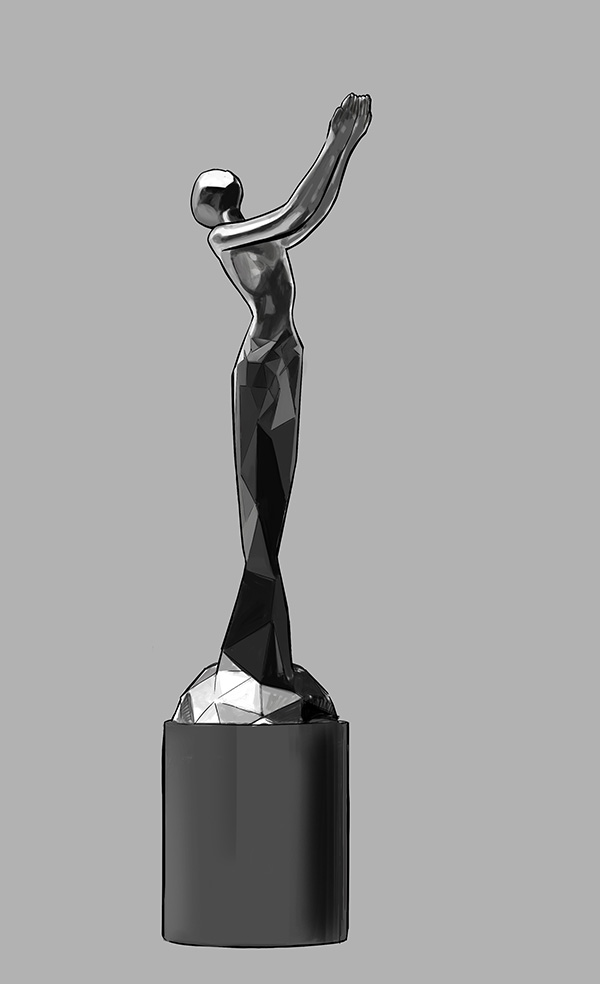
Spotlight: The top half of the new statute is pretty similar to Promax’s awards statue, while the bottom half is a departure. How did you end up there?
Hallas: The facets on the bottom half of the statute have gem-like aspects, which reflects back to the new organization’s acronym: GEMA. The original statute was standing on top of a sphere, representing the global aspect of the organization. The new one also stands on top of a partial sphere, which still represents the globe.
We spent weeks, if not a month or more, going back and forth on what the correct transition should be between the two halves. In some of the models, that transition was much sharper but we wanted something that felt more gradual. In some models, we had pieces where some of the facets were inset and others where they were pulled out. There was a lot of back and forth on what the art direction was going to be. It all gets a bit subjective, probably any of them would have worked, but it was a big collaboration to get it to where it finally ended up.
Edwards: We tried to make the statue very fluid from top to bottom. The bottom is faceted to connect the digital era to the top half of the statue, which represents the human being and the emotional expression that's at the center of all creative work.
Spotlight: Once you landed on a final version, how did you go about producing the statue?
Hallas: After the sketch phase, our artist, Ramona Clarke, used Cinema 4D to begin exploration of the pose. Even at that stage, we weren’t totally clear on things like the facets. She also used software like Z Brush, which has a standalone modeling component, and could quickly iterate and move things around easily. From there, we could get a sense of what the statue looked like before committing to the refinement process. We also considered different versions – gold, silver, bronze and even black.
We also did some versions that didn’t have any facial features but we learned that without some facial features, it became a little alien-looking. It needed some recognizable facial features to tie it all together.
Edwards: We had a discussion when we first started designing it – ‘wouldn’t it be cool if it were black?’ Stacy knows that I’m never going to stop talking about my dream of giving out one special black GEMA statue every year.
Once we had a production-ready file, we sent that to a fabricator with a 3D printer. That final version went to production. There will still be some additional tiny refinements to the statute in 2026.
We all felt the statue should be a strong representation of the very thing that we’re honoring: outstanding achievement in entertainment marketing. If we’re going to recognize outstanding works of genius, the statue itself should be worthy of it.
Spotlight: This is an obviously self-serving question, but why do you think it’s important for people to have their work publicly recognized?
Edwards: It never hurts when someone acknowledges excellent work. I think it’s so meaningful to get recognition in your field.
Hallas: Art is inherently subjective. This is a way to give validation for all of that hard work. When you are spending most of your time cranking just to get through the work that’s in front of you, winning awards recognition can be hugely beneficial. You don’t get that in your day-to-day routine.